
Book Review: Shark In The Housing Pool: On The Run With The Secret Service’s Most Wanted
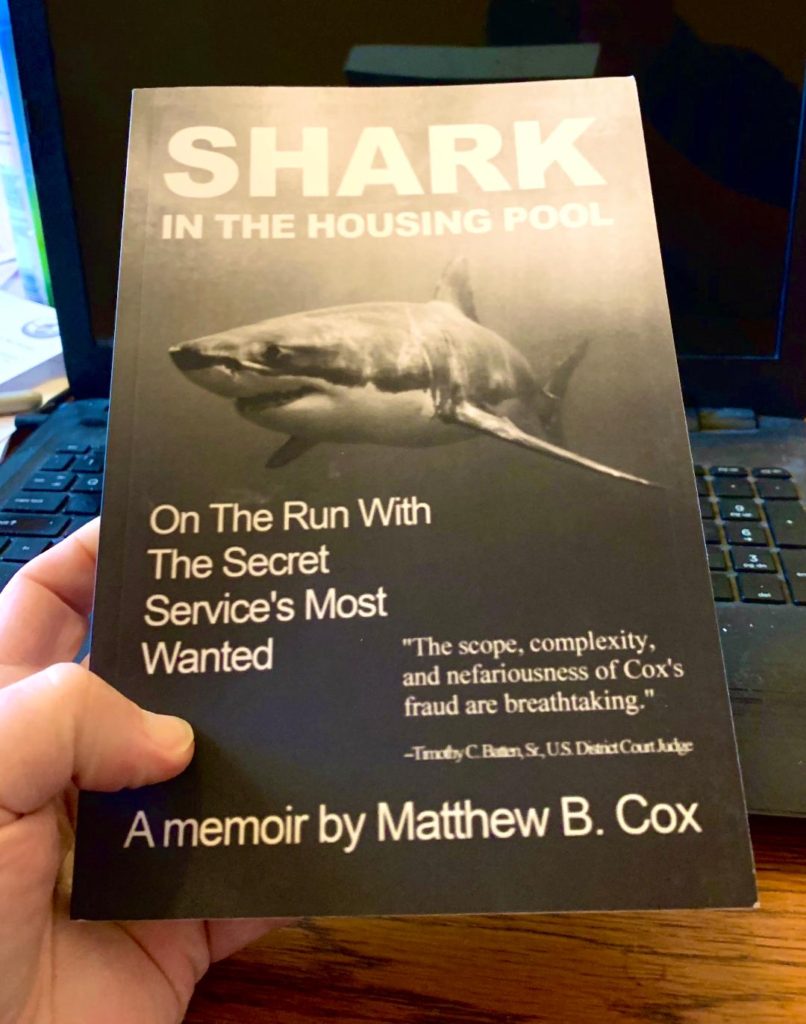
I first heard of Matt Cox several years ago because, well, I have a mild to moderate American Greed addiction. There I’ve said it. I have seen every episode of the show at least once and many of them multiple times. Now if you are not familiar with American Greed, it is a true crime documentary series where each episode focuses on one particular high-profile white-collar scammer. From Jorden Belfort (Wolf of Wall Street), to Tyco executive Dennis Kozlowski, to Kenn Starr, to the granddaddy of them all, Bernie Madoff. And the episode on Matt Cox was one that I watched on multiple occasions. Matt was estimated to have stolen 15 million dollars in an incredibly elaborate and creative set of mortgage scams. In fact, Matt stole 11 Million after being caught the first time and being placed on probation for fraud, and then another few million while on the run. Matt has been released from prison and has written his memoir entitled, SHARK IN THE HOUSING POOL: On The Run With The Secret Services Most Wanted. When starting the book, the first thing I noticed was that it passed my ‘first page test’. Over the years I have become a bit of a snob when it comes to writing ability and I have been known to close books after only a few paragraphs. On a few occasions, the first few sentences. But Matt’s book drew me in early with his warm and honest tone. Looking back on my life, if I’m going to be completely honest, I wasn’t even supposed to be here… There is a frank and simple style to his writing that falls in that — you can’t teach this, category. Not practiced or elegant, but also not formulaic or tried. This works well, because Matt has no formal training in writing and even battles with severe dyslexia, making the book and others he’s written, even more impressive. SHARK IN THE HOUSING POOL: On The Run With The Secret Services Most Wanted, details Matt’s life from birth until his capture and sentencing, and even gives a wrap up at the end, bringing the reader up to speed on what happened to others that are mentioned in the book. So did I like it? Yes. Yes I did. One of my few complaints about it is that after watching several of Matt’s video podcasts where he speaks about his life, you quickly see that he is one of the most charismatic and dynamic speakers I have ever seen. That actually works against him in this book, because I don’t think there is a writer around that can write, as well as Matt speaks. So if you are comparing this book to Matt’s numerous podcast interviews — that’s not a fair comparison. And since Matt published this book himself, since 100% of his income now comes from the art he sells and the books he writes, if you are a grammar-nazi, you will see some errors and a few formatting issues. But considering that Matt wrote this book while in prison, and the editing was having another inmate look it over, I think those few errors add a certain charm to it. My only other solid complaint about the book is that Matt is so honest, so up front about everything he has done, that sometimes there are more detail than needed on specific crimes and the story gets bogged down a bit. But it doesn’t last long. SHARK IN THE HOUSING POOL: On The Run With The Secret Services Most Wanted, is a good read. A fascinating tag along to a life that most of us will never see, and the life lessons from one who has. I give it four out of five stars.
The Self Help Of A Con Man: What convicted fraudster Matt Cox has to teach us about life
I tried to break my fall with my right hand, and that’s when the bones snapped — I mean, you could actually hear them break. I rolled over, got up off the floor, and just stood there. Waiting. The wrist looked okay. My fingers could still move. But that sound, that snap, was still in the air, and I knew something bad had happened. Then the pain arrived –sharp and intense, and then the arm began to swell and discolor. Later, the x-rays would show that the wrist wasn’t just broken; it was crushed. But all four bone pieces were still there, and we might be able to avoid surgery if we could cast it, keep it still, and hope for the best. Why am I telling you this? What does breaking my wrist have to do with talking to Matt Cox, one of America’s most notorious fraudsters, someone who is estimated to have stolen $15 million, was sentenced to 26 years in federal prison, and once held the number-one spot on the Secret Service’s most wanted list? Well, everything. Once the cast was on, my wife banished me to the couch, propped my arms with pillows and ice packs, and told me to stay there. So I did. And if I was real still, then the pain was minimal. So I sat and watched YouTube videos on my phone, which was propped against my cast. If I hadn’t broken my wrist, if I hadn’t had to just sit quietly for days at a time, I couldn’t have justified spending eight straight hours watching video podcasts of Matt Cox on a channel called Koncrete. Matt Cox began his career as a mortgage broker in the late 1990s. On his very first deal, a coworker advised him to alter a rental history document that showed the client had been 30 days late paying rent, which would have caused the loan to be denied. Matt made the change but was nervous as he waited to hear if the loan would be approved. He had violated the underwriting guidelines—and done so on his very first mortgage application. But his car was about to be repossessed, his credit cards were maxed out, and he was behind on his mortgage, so Matt needed the commission badly. Matt made the change but was nervous as he waited to hear if the loan would be approved. He had violated the underwriting guidelines—and done so on his very first mortgage application. But his car was about to be repossessed, his credit cards were maxed out, and he was behind on his mortgage, so Matt needed the commission badly. The loan went through, and at 29 years old, Matt realized that a few cents’ worth of Wite-Out had just netted him a $3,500 commission. The money got him back on his feet . . and also broke the seal to fraud. When clients who made $45,000 a year could only get a loan if they made $55,000, Matt, who had a degree in fine arts, manufactured new W-2 forms and verification of employment income. Matt closed four loans his second month as a mortgage broker and six loans the month after that. Then eight. Then twelve. He left that job and opened his own mortgage company. It had one rule: If someone walked through the door with a pulse, he would get them a loan. Matt had 14 people working under him and they were committing massive mortgage fraud. Things changed when the FBI caught some of Matt’s former business partners on a separate fraud case that Matt was connected to. These individuals wore a wire and met with Matt. He was unaware that he was admitting to all the details of his fraud—on tape. Matt accepted a plea deal and received three years’ probation, but now could no longer legally own a mortgage company. At this same time, Matt was going through a divorce, had given his ex-wife a large amount of money, and had a large monthly child support payment. He needed to make a living. So, he had an idea: Instead of making fake documents for people, why not skip a step and make fake . . . people? If he could create synthetic borrowers, then he could make some serious money. Matt estimated that every synthetic person he created netted him around $500,000. And he did it for two years. Matt Cox stole $11 million—all while on probation for fraud. About this same time, Matt started dating a woman named Gina Laidlaw. Gina was going through a divorce, raising her two-year-old child, and having some financial issues. Matt offered a way for her to make some quick money. Since Matt was obviously doing well and all his friends who were involved seemed to be successful, she agreed. Gina would play the part of a mortgage buyer named Rosita Perez. So, Gina—brown haired and green-eyed—dyed her hair for the fake ID photographs Matt created. Gina would show up at the closings with her ID and then go to the banks to deposit the checks. Later that year, Matt received a tip from a friend that the FBI planned to arrest him in a few days. He had over a million dollars in various banks, but couldn’t easily withdraw it, so he gathered the $80,000 he had in cash and went on the lam. By this time, Matt had stopped seeing Gina and was dating a woman named Rebecca Hauck. She showed up at Matt’s house to find him frantically packing his things. Matt explained that was going on the run from the FBI, along with the crimes he had been committing. Rebecca listened. And then told Matt that she was going with him. The two hit the road, and with Matt’s talent for false documentation, getting real driver’s licenses and even passports in other people’s names was never an issue. In the meantime, Gina was wracked with guilt over what she had done. A completely
Binghamton cool

There are few times in your adult life — maybe three times after your thirty and you might get one more in your forties — that you get to feel ‘cool’. I don’t mean the big ‘cool’ that you get to keep; the winning touchdown, the pushing someone out of the street right before the bus whizzes by, the snappy remark that wins the argument but also turns the crowd in your favor. And I don’t mean the forced cool, the notice me, the yeah, I just did that, kind. Nope. Cool, when it’s real, is a much deeper thing. It’s what you get when you don’t deserve it, but the people that are around you are so very cool, that before you know it, it’s all around your shoulders like a blanket. And you can’t believe how warm you are. And this is the real ‘cool’. Not a condition, but an action. Not people that are necessarily cool, but people that act cool to each other and to you. We are in Binghamton, New York and Binghamton has made me feel cool. This area is the place that used to be home and now just where all the memories are stored — which isn’t a bad thing — but a small group of people that I have spent the last day with, are very cool people. We are here doing two things. We are pre-launching the new book THE INVENTION OF EVERYTHING: Insights on Life, Food, and one good Thermos. And since the book has ties to Binghamton we have expanded that to making the book tour the frame for a documentary about the arts scene in the area entitled BINGHAMTON: Valley of Creativity. That we will be premiering at The Broome County Arts Council in February. Which is amazing. And we put together a team. Two videographers, a still photographer, a drone pilot along with my publisher and myself, to film all we need in two days and then go back and turn it all into a film to premiere in Binghamton in February. And yes, I spent five hours yesterday on-set getting to interview, one-on-one, some of the most talented and gifted people I have ever met. And I could ask them anything and it was open and real and true. Yup. And that was cool. But there was also having to shoot the same scene three hundred and eleven times in front of Mather Street, to get the ‘Walking tour of Cecils’ part just right — that wasn’t so cool. But the coolness that came later at the book signing at The Belmar, was worth waiting for. These people, these videographers — kids really, the age of my own kids — who had only known each other for minutes before I got to the first shoot — gelled like they had grown up together. This still photographer — a vibrant, confident, energetic young woman who seemed like she had been born with a camera in her hand — took her place like she had always been there. In minutes, five strangers became a team. Then the coolness came. When Jen at the The Belmar brought me a hamburger, guessing how I would like it and brought it over to the book table. When Emily fussed with the sleeves of my jacket then brought me her favorite beer because she ‘knew’ I would like it. When Will grabbed boxes of books and placed them out on a table, even though that wasn’t his job and wasn’t asked to do so. When Charles joked and laughed and then became a phantom and got shots when I never knew he was there. When Ed, the owner of The Belmar, refused to take our money for food. When Connie, who was rushing to meet her new grandchild on a different coast, spent days on the phone, organizing not only the best of Binghamton to interview but a place for us to shoot. When Tara, the most camera-shy person I have ever met, agreed to be interviewed and traveled from New Jersey just to support one of her authors. When my old friend Tejay who interviewed me on his radio station that morning, hugged me and told me that he was proud of me. That was very, very cool. Today is day two. Tara, the publisher and I will meet our team this morning for another busy day. It will be productive. It will be fun. But I’m already watching the clock and knowing it will soon end. We will all go our separate ways. And I will remember how cool these people made me feel.
The Gallery …

When we watch movies — smart people call them films by the way — there are certain areas of life that we accept as fact on screen, that never, ever happen in the real world. One example of this is called Standard Urban Groceries, of SUB. Now, this is something that you see when they want the audience to know that the character has stopped at a grocery store before the scene has started. So, the scene will open with he, or she, carrying a single brown paper grocery bag and sticking out of the top of it you will see a loaf of French bread and the greens from a bunch of carrots. Always. In real life you will never see these things together in this way. Ever. But in films — see how cultured I am? — it happens so often that you don’t even record it as strange. But if it were to happen in real life, you’d go, — “Hey, where did you get that brown grocery bag and did you steal those carrots?” The same is true with what people do in movies and TV. Things that are very common for people on the screen, aren’t so common on this side of it. A perfect example of this is cocktail parties. Cocktail parties are constantly going on in films and TV. And I mean, regular everyday people, just like you and me, are always trying to get out of boring cocktail parties. These will be held by the boss, some powerful figure, or a character that we don’t like very much. I mean, if you track it, TV and movie characters spend a third of their life trying to weasel out of cocktail parties. Oh, and Art Galleries are another one they always try to avoid. A friend of a friend is always having a show at some snooty Art Gallery — this usually occurs during playoff time where a difficult conflict is had by the male character — and the spouse wants him to go with her. Now here is a confession. In my fifty-five years of life, I can tell you that I’ve never been to, or been invited to, a cocktail party. Ever. I’ve gone to parties, I’ve gone to parties where they’ve served cocktails, and I’ve gone to cocktail hours at events, conferences, weddings and the like. But never the type of cocktail parties that are seen on TV and films. And up until last Friday, I had never gone to a show at an Art Gallery. See, we live in the small town of Dover, Delaware — which is not exactly teaming with Art Galleries. We have Mattress Stores. But there is one gallery, it’s in the old part of town, on Loockerman Street, and it’s called The Dover Art League. Now the Dover Art League has showings of local artists all the time and I always see these notices and for the eleven years we’ve lived here, I’ve never gone. So last Friday I finally did. There were two artists at The Dover League, one artist had the entire downstairs — of this great old building — and another artist had the upstairs. There were, I don’t know, maybe a dozen people there, milling around and there was a lot of ooh-ing and ahh-ing just like you’d expect. In the business world, this is called Tradeshow-Euphoria. Where people are so excited to be out of the office for three days, that they can’t tell you how amazing your product is. Then, when they get home and start cooking their own meals again, this enthusiasm begins to fade. Now I don’t know anything about art. But I enjoyed the paintings I saw. But more importantly, I really enjoyed what I saw — with the artists. Because pride is a very delicate commodity. It can easily boil over and become boastful, even mean. It can bubble into arrogance or conceit. But these artists at The Dover Art League, had genuine — pride. Pride in their work, pride in having a showing, and pride in having others see what they did. This pride was contagious, it beamed from them, and you felt it as soon as you walked near. As soon as you spoke to them, as soon as you felt that smile on you. It was pure. It was genuine. And it was special.