
When we watch movies — smart people call them films by the way — there are certain areas of life that we accept as fact on screen, that never, ever happen in the real world.
One example of this is called Standard Urban Groceries, of SUB. Now, this is something that you see when they want the audience to know that the character has stopped at a grocery store before the scene has started. So, the scene will open with he, or she, carrying a single brown paper grocery bag and sticking out of the top of it you will see a loaf of French bread and the greens from a bunch of carrots.
Always.
In real life you will never see these things together in this way. Ever. But in films — see how cultured I am? — it happens so often that you don’t even record it as strange. But if it were to happen in real life, you’d go, — “Hey, where did you get that brown grocery bag and did you steal those carrots?”
The same is true with what people do in movies and TV. Things that are very common for people on the screen, aren’t so common on this side of it. A perfect example of this is cocktail parties.
Cocktail parties are constantly going on in films and TV. And I mean, regular everyday people, just like you and me, are always trying to get out of boring cocktail parties. These will be held by the boss, some powerful figure, or a character that we don’t like very much. I mean, if you track it, TV and movie characters spend a third of their life trying to weasel out of cocktail parties. Oh, and Art Galleries are another one they always try to avoid. A friend of a friend is always having a show at some snooty Art Gallery — this usually occurs during playoff time where a difficult conflict is had by the male character — and the spouse wants him to go with her.
Now here is a confession. In my fifty-five years of life, I can tell you that I’ve never been to, or been invited to, a cocktail party. Ever. I’ve gone to parties, I’ve gone to parties where they’ve served cocktails, and I’ve gone to cocktail hours at events, conferences, weddings and the like. But never the type of cocktail parties that are seen on TV and films.
And up until last Friday, I had never gone to a show at an Art Gallery.
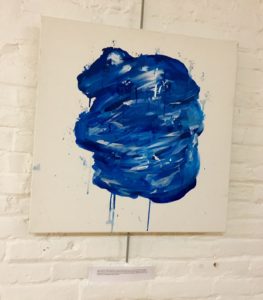 See, we live in the small town of Dover, Delaware — which is not exactly teaming with Art Galleries. We have Mattress Stores. But there is one gallery, it’s in the old part of town, on Loockerman Street, and it’s called The Dover Art League. Now the Dover Art League has showings of local artists all the time and I always see these notices and for the eleven years we’ve lived here, I’ve never gone. So last Friday I finally did.
There were two artists at The Dover League, one artist had the entire downstairs — of this great old building — and another artist had the upstairs. There were, I don’t know, maybe a dozen people there, milling around and there was a lot of ooh-ing and ahh-ing just like you’d expect.
In the business world, this is called Tradeshow-Euphoria. Where people are so excited to be out of the office for three days, that they can’t tell you how amazing your product is. Then, when they get home and start cooking their own meals again, this enthusiasm begins to fade.
Now I don’t know anything about art. But I enjoyed the paintings I saw. But more importantly, I really enjoyed what I saw — with the artists.
Because pride is a very delicate commodity. It can easily boil over and become boastful, even mean. It can bubble into arrogance or conceit. But these artists at The Dover Art League, had genuine — pride. Pride in their work, pride in having a showing, and pride in having others see what they did. This pride was contagious, it beamed from them, and you felt it as soon as you walked near. As soon as you spoke to them, as soon as you felt that smile on you.
It was pure.
It was genuine.
And it was special.