
We sit down with Everett De Morier whose book is being made into a movie

A major milestone for a Dover man. We sit down with author, Everett De Morier, to hear about how his book, “Thirty-Three Cecils,” is being made into a movie staring Dustin Hoffman.
Everett De Morier Speaks at Gannon Tuesday

‘Thirty-three Cecils’ novelists led writing workshop in Palumbo NADYA MAKAY/ KNIGHT Everett De Morier speaks to small group of students at afternoon workshop. Lia Eberlein, Staff Writer March 16, 2022 Author Everett De Morier visited Gannon University’s campus Tuesday, joining English professor Douglas King’s Literature and Film class and leading a writing workshop, both in the Palumbo Academic Center. De Morier’s 2015 novel “Thirty-three Cecils” is largely set in Erie and includes mentions of Gannon. During his time in the Flagship City, De Morier visited landmarks such as the Warner Theatre, Presque Isle, Hamot and various downtown locations. While speaking in King’s class, De Morier admitted that even though he has 30 years of writing under his belt, writing the screenplay for the film adaptation for “Thirty-three Cecils” was the hardest thing he’s ever done. He spoke to how difficult it is to include all the aspects of a film a viewer sees on-screen and translating that on paper. For this film adaptation, De Morier has been working closely with producer Brian Esquivel, known for “The Institute” and “Entourage.” When being asked by a student about the accuracy of book-to-film adaptations, De Morier said, “it’s my book, it’s their movie.” He further elaborated on how certain elements are unique to the novel and do not fit in the film, and vice versa. During his class visit, many students brought up a major question: why Erie? To this, the Binghamton, N.Y. native explained how Erie is far enough away from his hometown to be different, yet close enough for connections between characters to be realistic. He also told King and his students two stories of an Erie native colleague that he kept special memory of. To better understand Gannon’s home city, De Morier watched hundreds of YouTube videos of baseball games, church events and backyard cookouts —anything and everything that could help him better understand the primary setting of his story. Another major topic of the morning was publishing. De Morier put strong emphasis on how rejection plays a big role in trying to have pieces published and how many writers hold back from facing publishers due to fear of rejection. To this, he said that “you have to learn to love rejection.” De Morier followed this up with his own experience, and how each time the editor of “Thirty-three Cecils” reached out to him with critiques, he was excited for their input. I asked De Morier to describe his novel in three words, to which he responded, “It got published!” The author explained how this storyline is unique from what is typically picked up by major publishers like the Big Five, which includes companies Penguin Random House and Macmillan. “Readers are hungry for something that is different but real,” De Morier said, and expressed how the success of “Thirty-three Cecil’s” comes from its uniqueness. A small group of students joined De Morier for a writing workshop held in the English department’s conference room, where they were able to ask specific questions, share experiences and even some laughs with the author. De Morier shared details of the publishing process for “Thirty-three Cecil’s,” his opinions on traditional versus self-publishing, the importance of showing rather than telling in writing and gave students advice in response to various questions. He emphasized the consideration of how important it is to write, but it is even more important to have something to say. De Morier also explained how someone chasing money and fame can be successful, but true success is defined by the wanting to keep getting better, tying into his morning discussion about rejection. The final question of the afternoon was: what advice would you give to young writers? De Morier responded with two specific answers: to read — as the exposure to other writers’ styles can help you build your own — and to write badly. He said that writing badly isn’t something to be ashamed or afraid of; spilling everything out that’s in your head onto a page is very beneficial. Details of those bad writings can serve important roles in another piece. Tuesday evening, De Morier also led a reading of “Thirty-three Cecils” in Palumbo’s third floor atrium. LIA EBERLEIN eberlein001@gannon.edu This article first appeared in The Gannon Knight
Author of Erie-based Novel Set to Speak at Gannon
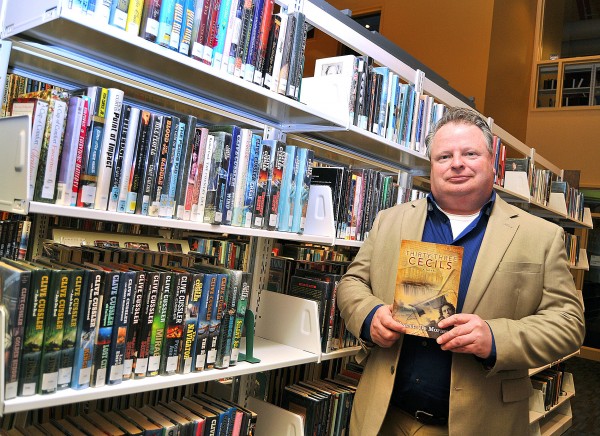
A novel set in Erie is projected to become a major motion picture soon, and better yet, the author of this novel is coming to visit Gannon University. Everett De Morier, author of “Thirty-three Cecils,” is scheduled to visit the campus Tuesday as a part of a speaker series hosted by English honors society Sigma Tau Delta. De Morier is a Binghamton, New York, native, and his small town upbringing influenced elements of his 2015 novel. He studied communications at State University of New York at Cortland and oddly enough has a mechanical engineering degree in his back pocket from DeVry University. De Morier began his authorial career with nonfiction but gravitated toward novels as his career progressed. Set in 1992, “Thirty-three Cecils” follows two very different men who met the same fate: they were murdered. One of these men is in fact from Erie, connecting this novel to the city Gannon calls home. “Thirty-three Cecils” will be produced in part by Kelly Fancher, whom De Morier said has been essential to having the film produced in his hometown of Binghamton. Although Erie won’t actually be the setting where the movie will be filmed, it will still remain the setting of the story. It will just be filmed exclusively in Binghamton. The movie has a $2.7 million to $7.5 million budget. De Morier spoke to the success of his novel, saying that “Thirty-three Cecils” won the top fiction prize at The London Book Festival and was named book-of-the-year by Heroic Magazine. “During that first year, it attracted the attention of some film people who read the novel and optioned the film rights,” De Morier said. The filming for “Thirty-three Cecils” is set to begin sometime this spring, and De Morier has quite the team behind him. De Morier wrote the screenplay along with a producer for the movie, Brian Esquivel. Esquivel eventually helped De Morier find producer Orian Williams to work on the project. Together, Esquivel and Williams compiled a cast list and a directorial team. Part of this cast was announced Tuesday. Academy Award winner Dustin Hoffman will have a role in the film adaptation of the novel, but his role has yet to be announced. De Morier said there is hope for more famous names to be added to the credits. “There are some A-list actors involved — one of which read the script 14 times,” De Morier said. “He said he had never read anything like it.” From all that has been revealed through the novel and about the film so far, De Morier’s visit to Gannon will further establish the bond of his book and the city of Erie. De Morier will begin his tour of Gannon Tuesday in a Literature and Film class taught by English professor Douglas King, Ph. D. From 3:30 p.m. to 4:45 p.m., De Morier and Sigma Tau Delta will be hosting a writing workshop in Room 3225 of the Palumbo Academic Center. The workshop is open to all students interested in discussing and learning more about writing and publication. The main event will end De Morier’s visit at Gannon and will take place from 7 p.m. to 8:30 p.m. in Palumbo’s third-floor atrium. ALI SMITH smith389@gannon.edu This article was syndicated from The Gannon Knight.
Binghamton Film Thirty-Three Cecils to Feature Academy Award Winner Dustin Hoffman

The star of “Tootsie,” “Kramer vs. Kramer” and “Marathon Man” is attached to a major motion picture that will be shot in Binghamton later this year. Academy Award winner Dustin Hoffman will have a role in the movie adaptation of Binghamton native Everett De Morier’s genre-defying novel, “Thirty-Three Cecils,” according to Kelly Fancher, a location scout and freelance producer who will be migrating to a staff position on the movie production team. The screenplay was also written by De Morier along with producer Brian Esquivel, whose credits include the 2017 film “The Institute.” Fancher, a New School University graduate and the founder of Milady Media, said she has been closely involved in development and location scouting for the movie, working with the author and producers to get the film made here. “It was the perfect type of film for all that Binghamton has to offer as far as locations, local talent, infrastructure, and tax incentives,” Fancher said in a media release. “The Binghamton region is so unique. We can shoot for several days downtown, then pack up and drive only a few miles away and be in the country.” “Thirty-Three Cecils” features several real-life Binghamton locations, including the apartment building at 1 Mather Street and The Belmar Pub. Novel set in Binghamton, Erie, Pa. Set in 1992, the novel unfolds through a long series of fortuitously discovered journal entries by two murdered men: a prominent cartoonist and documentarian from Erie, Pennsylvania, who goes to prison for forgery, and an alcoholic who works at the Broome County landfill until he decides to quit his job and set off on a life-altering bicycle journey. Both men live in different parts of the country and led completely separate lives — until their paths cross. It’s a novel about redemption, family and second chances. “I adore the novel. It’s such an amazing story,” Fancher said in the release. Ed Hickey, the owner of The Belmar Pub, has hosted multiple book events at The Belmar. “I loved the book,” Hickey said, according to the release. “It’s very unique, has a lot to say and Binghamton is seen through a very specific set of eyes. It also shows The Belmar Pub back in the days when my dad ran it.” Production will spend six weeks in Binghamton Esquivel has been “a champion of this project from the very beginning,” Fancher said. She added, “He always calls it ‘the beautiful film.’ Brian is very excited about the ‘Thirty-Three Cecils’ film and is looking forward to the day when he and Everett can have their very first beer together at The Belmar.” Fancher, who is also from the area, said in a telephone interview the movie production team will be in the Binghamton region for about six weeks. The Erie scenes will also be shot in Binghamton and the production is in talks to utilize the former Davis College in Johnson City for significant filming. Shooting is also expected to take place around Niagara Falls, another key location in the story. The shooting schedule depends on the availability of the cast and others. The production had been tight-lipped about possible cast members prior to announcing Hoffman’s involvement. “The producers … are now working with the schedules of some very talented and very busy individuals that are in high demand,” Fancher said. “Once we have a schedule that works for everyone involved, we will publicly announce the cast and schedule to the trades. It will be sometime this year.” The movie will have a “Tier 1” budget, which ranges from $2.7 million to $7.5 million. Fancher said producers are not ready to announce the director, but she added, “You will know who it is, I can tell you that, but I am not at liberty to say right now.” Binghamton has other star turns on the silver screen. “Liebestraum,” a 1991 movie directed by Mike Figgis, was shot in and around Binghamton. “The Rewrite,” a 2015 romantic comedy written and directed by Binghamton University alum Marc Lawrence and starring Hugh Grant, was set in Binghamton but was actually shot on Long Island University’s Post campus in Nassau County. De Morier, who was was born in Binghamton, currently lives in Dover, Delaware, with his wife and two children. He will return to the area March 16 to speak with film and English students at SUNY Broome and cinema students from Binghamton University. Follow Neal Simon on Twitter @HornellTribNeal. To get unlimited access to the latest news, please subscribe or activate your digital account today
Filming of Major Motion Picture Thirty-Three Cecils to Start Soon

A major motion picture is expected to start filming this spring in Binghamton. Walton native Everett De Morier co-wrote the screenplay which is based on his novel Thirty-three Cecils. The story is set in Binghamton and Erie, PA. “Binghamton will be Binghamton because there are certain locations in the screenplay that are still there,” De Morier said in an exclusive CNY News interview. De Morier added that Erie locations will also be shot in Binghamton because the cities resemble each other. “The story is about two totally different people that have realized that they’ve messed up their lives,” De Morier said. “One is an alcoholic who lives in Binghamton and realized every decision he’s made has led to problems.” The second character lives in Erie. “He was once a very prominent man who was the darling of the community,” De Morier said. “Things got tough, he became a counterfeiter, went to prison and became the joke of the town.” The two characters paths cross in the movie. “This is a story of redemption,” De Morier said. He believes viewers will relate to the theme because, “we all need to forgive ourselves, move on, dump the shame and get to the next step.” Ongoing contract negotiations prohibit De Morier from identifying the actors and director. “But the casting is done and these are names that you’ll definitely recognize,” De Morier said. The film, budgeted at about $6 million, allows for some local actors and crew to be hired. Read More: Filming Starts Soon In Binghamton On A Major Motion Picture | https://cnynews.com/filming-starts-soon-on-a-major-motion-picture-based-on-the-novel-thirty-three-cecils/?utm_source=tsmclip&utm_medium=referral
Walton Graduate’s Novel Thirty-Three Cecils Will Be Turned Into a Movie

A Walton native has turned his award-winning novel into a screenplay, and a movie based on it will be shot in Binghamton later this year. Everett De Morier, whose book “Thirty-three Cecils” was released in 2015, said he wrote the screenplay with Brian Esquivel, who is producing the movie. “It’s surreal,” he said of having his book turned into a movie. “It’s exciting. I’m very excited.” De Morier attended SUNY Oneonta in 1985 and worked at Red’s Filling Station, a college bar on Market Street. He was raised in Walton, graduated from Walton Central School in 1981 and was the commencement speaker for the 2019 Walton graduation, a media release said. The book is based in Binghamton, where De Morier lived in the 1990s, and Erie, Pennsylvania, a place he has never been to, he said. Instead, he researched the city online and looked up images of different addresses so he could describe them in his book. He said his description was so vivid, a reporter “asked me how long I lived there.” He said he will visit Erie later this month when he tours and speaks at Gannon University on March 14 and 15. He will speak to residents as well as to students in several writing and film classes, a media release said. He will be in the Binghamton area on March 16, where he and Kelly Fancher will speak with film and English students at SUNY Broome and cinema students from Binghamton University, the release said. Fancher, a former film commissioner for the Binghamton Film Office, will be migrating to a staff position with the “Thirty-Three Cecils” film, the release said. While the book takes place in the two cities, the entire movie will be shot in Binghamton, De Morier said. He said it was nice to see that a pub he wrote about was still open. The movie will be shot at different locations within the city including the Belmar Pub, he said. The pre-planning of the different shots will take between three and four weeks and the movie will be shot in six weeks, he said. The production crew is coordinating with the actors, whose names have not been publicly released, to see when they are available to shoot the movie. He said the movie will be shot out of sequence. For example all of the scenes that take place inside the pub will be shot together. De Morier said he will be on the movie set from beginning to end, tweaking the script if needed. “Writers are not the favorite people on the set,” he said. “For some reason they want the writers as far away as possible.” The novel won the top fiction prize at The London Book Festival, the release said. De Morier said it is used in some prisons to teach fiction writing to prisoners. He has spoken at colleges and has had conference calls with prisoners, and noted that the students often ask how to find an agent and publisher, but the prisoners ask: “How do I make this paragraph better? How do I better my craft?” Vicky Klukkert, staff writer, can be reached at vklukkert@thedailystar.com or 607-441-7221. Follow her @DS_VickyK on Twitter.
Everett signs to be represented by The Seymour Literary Agency
Thirty-three Cecils, named in Best Books by Southern Tier Authors
Everett keynote speaker at SUNY Broome, in Binghamton, NY
The Shack

Okay, here is an experiment. I’m going to ask you a few simple questions and all you have to do is picture the answers in your head. That’s it. Ready? You are traveling. You can do this in any way you want, your choice, you just need to get to a different location, so you decide how to get there. Once you have determined this, begin the trip. Picture all that’s around you, take it all in. On your travels, you come across a cup. This can be any type of cup at all and you can do anything with it that you want. See the cup, take in all the details, decide what you are going to do with this cup, and then we’ll move on. Next you find a key. This can be any kind of key at all, and again, you can do anything with it you like. Picture all the details of the key, decide what you are going to do with it, and move on. As you are traveling, you come across a body of water. It can be any body of water at all. Picture all the details of the water as you decide what you will do when you come across it. Then, we move on. Lastly, we come across a house, any kind of a house. Picture all the details. You can do anything you want with the house and we move on. Okay, that’s it. You’re done. So, how did you travel? By foot, by plane, by boat, by unicycle? Was it a fast trip or a slow one? Was it chaotic and exciting, or calm and relaxing? How you chose to travel, represents how you see life. Was your trip crazy and frustrating, or was it calm and direct? Picture how you saw all this in your head. What images can you pull that show how you see life? Were the windows down in the car? Was the sky clear from your airplane window? Was there a warm breeze going by as you walked? The first thing you came across on your trip was a cup. The cup represents how you view relationships. Was your cup a crystal goblet or the empty plastic container from a Big Gulp? What did you do with the cup? Did you leave it behind or take it with you? Next you came across a key. The key represents knowledge. Was the key a shiny brass skeleton key, or was it a rusting car key stuck in the mud? What did you do with this key? Then you came across a body of water. The body of water represents how you view sex. Was the water a raging ocean, or a mud puddle? Was it a clear stream or ditch? What did you do when you came across the body of water? And lastly, you came across a house. The house represents how you see . . . you. How you picture yourself. Was it a five-story mansion or a rusting trailer up on cinder blocks? Was it a comfortable home, a small cabin, or a castle looking over the ocean? Now, if you saw the key as a broken sardine-can key, does it mean you crave ignorance and despise knowledge? No. If the cup you saw was a disposable fast-food one that you ran over with your monster truck, it doesn’t necessarily mean you see people as unimportant and easily replaceable. At least, I don’t think so. This is just one of those personality tests, and I’m not sure anyone really knows what (if any) science is actually behind it. But, with me, this little personality test pointed out something very important. I took this test about thirty years ago when I was in college. I was in a dark room, I had my eyes closed, and I had a friend speaking to me, guiding me into a deep trance. “You are traveling.” Her words guided me. I was traveling. On the path, I saw something. It was dark and rough and sat on top of the hard-packed dirt. It was a key. An old iron and hand-forged skeleton key, but this key was large, the size of a pair of glasses. I picked it up. It was heavy and important, so I took it with me. I started walking again and saw something else. There, ahead in the grass. Its faint red and blue color made it easy to see, but I couldn’t quite make out what it was until I got closer. When I did, I saw that it was a teacup. I bent down to look at it. It was a delicate thing with painted leaves and ivy on the outside and a soft spiderweb of gray cracks inside. When I picked it up, I noticed it weighed almost nothing and that it had one small chip on the rim. It was delicate and rare. I held it by the handle and looked at it. I liked it, so I took it with me. The path became shady as it wound into some woods. I followed it and could see something glimmering ahead. I got closer and saw that it was a small lake. Because I had nowhere to go, I sat down at the base of a tree in the shade and just looked at the lake. Now, this is where the story gets strange. As I walked away from the lake, as I got into a darker part of the woods, the trees were closer together and I saw something ahead in the dead brush off the path. You could tell right away that it was some sort of building. As I got closer, I could see it was an old abandoned shack. It was small, not much bigger than a garden shed, but I knew it was meant to be someone’s home. The clapboard door was hanging on its hinges—hinges that were really only thick pieces of leather