Thirty-Three Cecils Day
Every September 1 in Binghamton, New York, friends gather at the Belmar Pub. They raise a glass, share stories, and toast two men who died on that date years earlier. The tradition has now entered its fifth year. What makes it unusual is that the men being remembered never lived. They are characters from a novel.
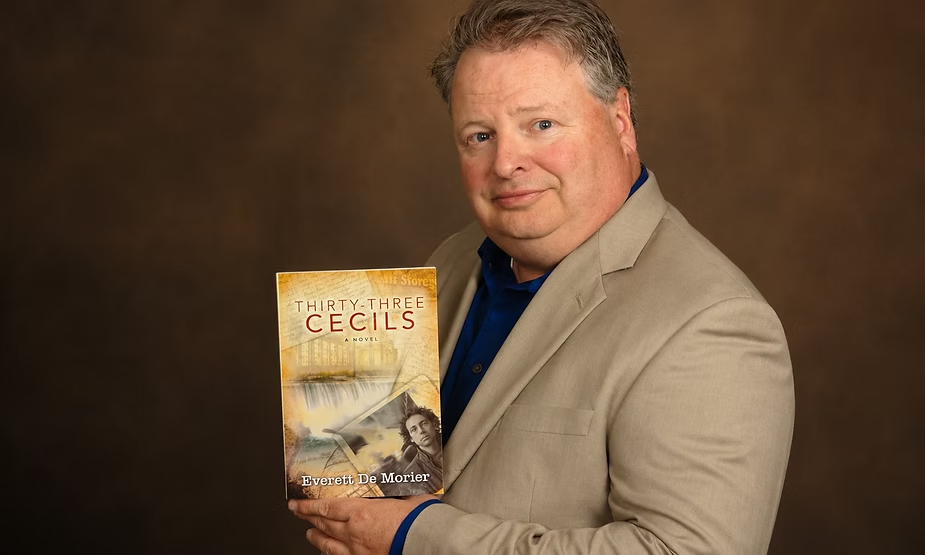
Thirty-Three Cecils, set in recognizable places throughout Binghamton and Erie, Pennsylvania, has blurred the line between fiction and the real city. Because the book uses actual streets, landmarks, and geography, its world has taken on a life beyond the page. For many readers the Belmar is no longer just a setting on a printed map. It is the place where Riley “Dutch” Dutcher lived, drank, and dreamed. Walk past it on an ordinary afternoon and you might still catch yourself glancing at the door as if he might step out.
The holiday began quietly in 2022 when a reader named Mike Pedley made a personal pilgrimage to the Belmar. He had finished the novel and could not shake the final pages. He knew that September 1 was the date on which the central characters meet their fate, and he knew the bar was a real Binghamton location. So he went. He sat down, ordered three beers the way Dutch once did in the story, and raised them in silence. Someone at the bar took a photograph and sent it to the author, Everett De Morier.
De Morier and his publisher were moved by the gesture. The following year they returned to celebrate the day themselves. Word spread through the growing circle of readers and the first formal gathering filled the bar with people who had never met but already shared a private language of names, places, and scenes. The following year, 2025, Binghamton Mayor Jared Kraham had officially declared September 1st, Thirty-Three Cecils Day. A fictional date had become a civic one.
In the years since, the novel’s reach has continued to expand in unexpected ways. Fans have named pets after characters. A local brewery created a beer in the book’s honor, and a signature cocktail followed. A production company, Gopher Ink, took their name from the novel. Fan art was created and the world of Thirty-Three Cecils even grew outward into the children’s book 100 Cecils, introducing a new generation to the spirit. What started as one reader’s private toast has become a small but stubborn tradition that refuses to stay on the page.
The author has embraced it fully. In 2024 De Morier took the tribute further, pledging to bicycle the 264 miles between Binghamton and Erie—the same journey Dutch makes in the novel. The ride turned a fictional route into a real one, with the writer moving through the same landscape his character once traveled. Readers followed the progress and the distance between story and life narrowed again.
What began as a quiet act of remembrance has become something larger than book promotion. It is a community tradition that grew organically from the relationship between a story and a place. There are book festivals, literary landmarks, and fan conventions across the country. Thirty-Three Cecils Day is different. It is an annual local holiday built around a specific novel, a specific date in that novel, and the real city in which the story unfolds. It belongs as much to the people who live in Binghamton as it does to the people who only visited it through the book.
Sometimes readers visit the places described in a novel. Sometimes they raise a glass to characters who never existed. Sometimes a date on a fictional calendar becomes a date on a real community calendar. And sometimes a city gives that date an official name.
That is what has happened in Binghamton. Every September 1 the city celebrates a story that began as fiction and became real enough to matter. Walker and Dutch died on September 1 in the novel. The story did not die with them.
Binghamton kept it alive.