
 Writing is a pretty solitary deal. I mean, you sit in front of a computer and you press little buttons, alone. A creative game sure, but a single player one.
Now you can make the setting a little more exotic if you’d like and have the writer in a dark and smoky bar or a sidewalk café, scratching together a few stubborn lines with a fountain pen in one hand and a tumbler of whiskey in the other. And I’m sure someone, sometime, someplace has done that. But the process itself still contains one single person funneling their thoughts to paper. And even though you can be in a crowded room while writing, it’s still done alone.
But let’s fast forward to the glamorous goals of the writing process. Let’s say the book you are working on becomes a huge success, the novel becomes a bestseller, your screenplay is picked up by Warner Brothers, and there are awards and banquets and guest appearances and book signings and Ted Talks and television interviews and red carpets and all those amazing accolades celebrating how brilliant you are and all of them will be done in large social groups.
Sure. During that part you’re not alone. But this is a celebration once the work is complete. The work you did alone. A celebration of your solitary efforts — and for the ego of most of us writers, this is not a bad thing at all that it’s all about us. But the entire journey to get there, that was done by yourself. Which means you get to claim all the rewards, but you also had to you carry the entire burden.
So here is what I’ve discovered recently that is, well, it’s pretty frickin’ amazing. And once I discovered it, it changed everything about how I write.
No, that’s not true. It changed the drive behind the writing. The reason. The rules. But first I have to tell you about my story. My very cool story that happened last night because, well, because it’s the coolest story ever and I’m dying to tell you.
Ready? Okay, here we go.
Last night, about one in the morning, I got out of bed to, well, to do what middle aged men do a few times each night. And when I had finished that chore, I saw that my cell phone on the dresser was lit up. I almost always leave the phone in the office downstairs but had it in my pocket when I came up and didn’t feel like walking it back down. So I turned the ringer off and left it in the dresser. But the screen was now lit, meaning that a text had just came through.
I looked and saw that it was from Jesse, one of the producers of the Thirty-Three Cecil’s, film. It read, WE FOUND THE CAR. CALL ME WHEN YOU CAN.
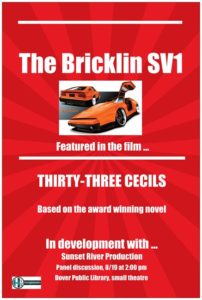
Now I assumed that the car Jesse was talking about, was the Bricklin SV1. A big part of the novel and one that would be a pivotal scene in the film. And since it was only 10:00 pm on west coast, I called Jesse back. Jesse quickly conferenced called in Kate, the script producer.
Which means that I now get to now drop this incredible phrase into a cocktail party discussion — if I’m ever invited to a cocktail party. — that goes, “Oh sorry if I yawned, I had a conference call at 1:00 am this morning with the producers in L.A. concerning my novel that they are turning into a film” Which although obnoxious, would be fun to say and is probably the very reason I don’t get invited to cocktail parties.
“You found a Bricklin?” I asked Kate.
“We found three,” Kate answered, excitedly. And she told me about how in just a few hours of looking they had tapped into this Bricklin community that was downright giddy that a film was being made with a Bricklin in it.
Jesse and Kate had been working on the budget that day and this was the first time we had talked since going over the script notes they had for me, the week before.
“And let’s talk about that,” Jesse joked. “You rewrote that entire script, did it well, in two days. That’s pretty impressive.”
Now this may sound boastful mentioning this, and I don’t mean it to be, but it’s necessary because Jesse’s comment is needed to start talking about this writing thing. About the very aspect I’m writing about here. So let’s start with that.
Have I learned to write decent dialogue and write it fairly quickly? Sure. But how?
Well, I didn’t learn it from classes or workshops — not that these don’t have value — but I learned because for eight years I volunteered to work with an amazing group of actors and singers where I got to write an original play each year, every year. Because of that, I had to learn to make dialogue count, to make each word matter, and to do it quickly.
In fact, there was even one year that a few days before the reveal, we realized that the script I had written was crap. So we scrapped it. And I wrote a new one in a week. A better one that we were all happy with and we filled every seat for the four shows.
Now was I able to do this because I have any more talent or drive than anyone else? Absolutely not. I got good at dialogue because there were people that were counting on me to do so. People that needed my work to be good, so there’s could be. Which leads me to this first discovery.
#1. The most fulfilling writing is done in writing projects, not in writing.
The greatest joy I get from writing, comes from writing projects I’m involved in, where the writing is only part of something else. Something bigger. From plays, to a documentary, to short videos, to skits — getting to work with others, towards a common goal, is the coolest thing ever.
And this occurred once I realized that —
#2. The best partners are the ones you don’t pay.
Over the last few decades, I’ve paid a few people to help in different aspect of writing: marketing, promotion, editing, etc. And all of those people have on thing in common. They are all gone. They did their job and then they left.
Now I’m not saying that you shouldn’t pay people for writing services. Nope, I get it. But I am saying that payment — is the payment. And if that payment is monetary up front, then the goal is to earn that fee. But if the goal is to be a part of getting the project to it’s goal, even if that goal is for everyone to get paid, then that is the fee.
Because the most incredible writing partnerships I’ve developed over the years are the ones where my partners only win — if I win.
From Tara, who helped me get the last two books as good as they could be and put her own money and time and resources into publishing them.
With Jesse and Kate, who don’t seem to ever sleep and at times are more excited about this film than I am.
To Dave, who was not afraid to tell me when a character or aspect of the play wasn’t working so we could make it better.
These people were not paid. They were partners.
Now I don’t know what writing has in store for me. If I will, or even want to get to a point where I make a soul living by it. Not sure. But I do know that I wont do it alone.
Writing has become and will now be — a group activity.
So develop a project. Then go find people that believe in it to become partners with you.
And then write.